14 Theseus
Theseus: fast and optimal affine-gap sequence-to-graph alignment
Abstract
Motivation: Sequence-to-graph alignment is a central problem in bioinformatics, with applications in multiple sequence alignment (MSA) and pangenome analysis, among others. However, current algorithms for optimal affine-gap alignment impose high memory and computational requirements, limiting their scalability to aligning long sequences to complex graphs. Practical solutions partially address this problem using heuristic strategies that ultimately trade off optimality for speed.
Results: This work presents Theseus, a novel, fast, and optimal affine-gap sequence-to-graph alignment algorithm. Theseus leverages similarities between genomic sequences to accelerate the alignment computation and reduces the overall memory requirements without compromising optimality. To that end, Theseus exploits the diagonal transition property to process only a subset of the dynamic programming cells, combined with a sparse-data strategy that enables efficient sequence-to-graph alignment. Moreover, our algorithm supports optimal affine-gap alignment on arbitrary directed graphs, including those with cycles. We evaluate Theseus on two key problems: multiple sequence alignment (MSA) and pangenome read mapping. For MSA, we compare it against the state-of-the-art methods SPOA, abPOA, and POASTA. Theseus is to faster than the other two optimal aligners, SPOA and POASTA. Compared with abPOA, a heuristic aligner, Theseus is faster on average, while ensuring optimality. For pangenome read mapping, we benchmark Theseus against the alignment stage of the popular mapping tool vg map, along with the alignment kernels of SPOA, abPOA, and POASTA. Theseus outperforms the other methods, showing a to speed improvement on short reads.
Availability: Theseus code and documentation are publicly available at https://github.com/albertjimenezbl/theseus-lib.
Contact: albertjimenez.blanco@upc.es
1 Introduction
Sequence-to-graph alignment is a central problem in modern bioinformatics (Eizenga et al., 2020) driven by the growing use of sequence graphs to compactly model genetic diversity (Miga and Wang, 2021; com, 2018) and reduce reference bias (Garrison et al., 2018). Consequently, sequence-to-graph alignment has applications across multiple fields, including comparative genomics (Tettelin et al., 2008), evolutionary biology (Zhang et al., 2019), and pangenomics (Liao et al., 2023), among others (Compeau et al., 2011; Miller et al., 2010; Marco-Sola et al., 2012; Marco-Sola and Ribeca, 2015), enabling fundamental tasks such as Multiple Sequence Alignment (MSA) (Lee et al., 2002) and read mapping to pangenome graphs (Rautiainen and Marschall, 2020).
Multiple Sequence Alignment (MSA) is a fundamental analysis in bioinformatics and genomics (Gotoh, 1999), providing the basis for studying conservation, variation, and evolutionary relationships across sequences. To that end, Partial Order Alignment (POA) (Lee et al., 2002) is a widely used method that progressively builds an alignment of a set of sequences. In its original formulation, POA provides an efficient and informative solution to the MSA problem (Lee et al., 2002), progressively building a partial order graph that represents the incremental multiple alignment. This is done by iteratively aligning each new sequence to the current sequence-graph and then updating the graph to incorporate each newly computed alignment.
Similarly, pangenome read mapping has emerged as a fundamental problem in bioinformatics, crucial for analyzing genetic variation across populations by replacing traditional linear reference with pangenome graphs. Initiatives such as the Human Pangenome Reference Consortium (Liao et al., 2023) and the 1000 Genomes Project (Consortium et al., 2015) reflect the growing interest in efficiently modeling genetic diversity and reducing reference bias in the analysis of highly variable regions, such as the Major Histocompatibility Complex (MHC) (Chin et al., 2020). Similar to traditional read-mapping tools, most currently used pangenome read mappers (Garrison et al., 2018; Rautiainen and Marschall, 2020) implement the seed-and-extend paradigm. This paradigm consists of two phases: (1) A seeding strategy is used to find candidate mapping locations, and (2) These candidates are extended using an alignment algorithm to determine the better-scoring locations in the reference pangenome graph. Current pangenome read mappers usually work with directed acyclic graphs (DAG) (Garrison et al., 2018) or admit small cycles (Rautiainen and Marschall, 2020), but do not directly support large cycles. VG implicitly represents such cycles by unfolding the cyclic components in the reference pangenome. However, this unfolding process can substantially increase the size of the unfolded graph with respect to its cyclic counterpart (Kavya et al., 2019).
However, the large scale of sequence-graphs used for MSA and pangenome analyses, combined with the ever-growing volume of genomic data (Goodwin et al., 2016), places significant stress on traditional sequence-to-graph alignment algorithms (com, 2018; Lopez-Villellas et al., 2024, 2023). Even for the simplified version of DAGs, the algorithmic cost of traditional algorithms grows proportionally to the product of the number of bases in the reference graph and the length of the aligned sequence (Jain et al., 2020). The problem becomes harder when considering cyclic graphs. As a result, traditional methods require high memory and runtime and scale poorly when dealing with large numbers of sequences or complex, large pangenome graphs (Darby et al., 2020).
Classical solutions rely on extending the dynamic programming (DP) formulation of sequence-to-sequence alignment (Needleman and Wunsch, 1970) to sequence-graphs. Navarro introduced the first such extension, proposing a DP algorithm that computes the optimal alignment of a sequence to an arbitrary graph for approximate hypertext matching (Navarro, 2000). This foundational algorithm was later extended to support arbitrary costs (Jain et al., 2020). However, its time and memory demands make it impractical for large-scale genomic data, which has motivated the proposal of multiple constant-factor optimizations, such as SIMD vectorization and bit-parallel techniques (Myers, 1999; Doblas et al., 2023, 2025b). Notably, SPOA (Vaser et al., 2017) is a widely used state-of-the-art POA library for computing MSA that speeds up the traditional DP computation through SIMD vectorization. Similarly, GraphAligner (Rautiainen et al., 2019; Rautiainen and Marschall, 2020) is a widely used pangenome read-mapping tool that speeds up edit-distance computation through bit-parallel techniques.
In contrast to optimal approaches, many practical implementations employ aggressive heuristics to accelerate computation and reduce the memory usage at the expense of accuracy, often missing the optimal alignment solution. Examples of such heuristic strategies include the banded alignment mode of GraphAligner (Rautiainen and Marschall, 2020), the seed-chaining approach of minigraph (Li et al., 2020), and the adaptive banding in abPOA (Gao et al., 2021).
More recently, new output-sensitive methods (Doblas et al., 2025a) have been proposed whose runtime scales with the difficulty of the alignment (i.e., alignment score), adjusting to the workload complexity. Notably, the Wavefront Alignment algorithm (WFA) (Marco-Sola et al., 2021, 2023; Aguado-Puig et al., 2023; Haghi et al., 2023; Alonso-Marin et al., 2024) introduced an output-sensitive formulation that achieves optimal sequence-to-sequence alignment, but it is limited to linear references. Other methods, inspired by classical informed searches (Hart et al., 1968), implement -based strategies to reduce the number of DP cells explored in graph alignment. POASTA (van Dijk et al., 2025) and Astarix (Ivanov et al., 2020) follow this strategy, reducing DP cell computations at the expense of overheads for maintaining a priority queue, computing the heuristic function, and requiring additional memory.
In this work, we present Theseus, a fast and memory-efficient output-sensitive algorithm for optimal affine-gap sequence-to-graph alignment. Inspired by the WFA algorithm for sequence-to-sequence alignment (Marco-Sola et al., 2021, 2023), Theseus exploits the similarity between sequences to accelerate computations and reduce memory footprint. Unlike other sequence-to-graph alignment algorithms tailored for specific use cases, Theseus is flexible enough to be applied to many sequence-to-graph alignment applications. Moreover, Theseus works on directed graphs and supports cycles, efficiently addressing the sparse nature of graph exploration.
We evaluate Theseus on two fundamental and critical applications: MSA computation and pangenome read mapping. First, for MSA computation, we compare Theseus against the state-of-the-art POA methods SPOA and POASTA (exact) and abPOA (heuristic). Our results show that Theseus is to faster than the other exact aligners. Moreover, Theseus is faster on average than abPOA, while ensuring optimality. Second, for read mapping, we compare Theseus against the sequence-to-graph alignment kernels in vg map, SPOA, abPOA, and POASTA. In this experiment, Theseus outperforms the other methods, showing a to speed improvement on short reads.
In summary, this work makes the following contributions.
- We present Theseus, a novel output-sensitive algorithm for fast and memory-efficient computation of optimal affine-gap sequence-to-graph alignment that supports reference graphs with cycles.
- We propose a diagonal invalidation strategy that compactly represents and updates the set of invalid alignment diagonals, eliminating redundant computations during sequence-to-graph alignment.
- We introduce sparse wavefronts, an efficient data structure to store intermediate wavefronts over sequence-graphs.
- We also propose a sequence-graph unified coordinate system to efficiently operate over multiple sparse wavefronts across the vertices of a sequence-graph.
- We introduce a memory-efficient backtrace algorithm to recover the optimal alignment path from sparse wavefronts over sequence-graphs.
- We provide a high-performance, open-source implementation of Theseus, distributed as both a library and two stand-alone minimal tools, publicly available to the community.
2 Background
A sequence-graph is a tuple , where denotes a set of vertices, its set of directed edges, and assigns a sequence of symbols over alphabet to every vertex. For simplicity, we denote the length of the sequence associated with as . Given vertices , a path from to is defined as the ordered sequence of vertices connected by edges in the sequence-graph . Any path has an associated sequence-path obtained by concatenating the sequences of its vertices. Let be a sequence of length , which we name query, and let be a sequence-graph, which we name graph-reference. Then, the optimal sequence-to-graph alignment is the sequence of four basic operations (i.e., match, mismatch, insertion, and deletion) that transform into a sequence , spelled by a path in originating at some vertex , while minimizing a given score function.
Most practical applications employ score function models: gap-linear and gap-affine. The first is the simple gap-linear score function (also known as weighted edit distance), which assigns fixed penalty values for matches, mismatches, and gap extensions (applied to both insertions and deletions), respectively. The second model is the affine-gap score function (Gotoh, 1982), defined as a tuple of four values, where is the cost of a match, is the cost of a mismatch, is the cost of opening (starting) a gap and is the cost of extending it. This formulation models the fact that starting a new gap is more expensive than extending an existing one. For example, two insertions interrupted by another operation require paying two gap-opening and two extension penalties , while a single uninterrupted two-base gap costs only . Using a gap-affine function allows treating long gaps as a single event rather than multiple independent edits, yielding more accurate biological interpretations.
The optimal sequence-to-graph alignment can be computed using the recurrence equations in Eq. 1. and represent the optimal score to align the prefix against any valid path that reaches offset of vertex and ends in an insertion or a deletion, respectively. The third value, , represents the optimal alignment score of reaching position , regardless of the last edit operation. The initial conditions at each vertex depend on the last scores computed at every vertex with an incoming edge to ; i.e, .
(1)
In practice, solutions to Eq. 1 are computed using DP, as the problem exhibits optimal substructure where every partial solution of an optimal alignment is optimal. Common implementations under the affine-gap model allocate three DP matrices per vertex (, , and ) of dimension . This results in time and space complexity (Navarro, 2000), with the total length of the sequences in the graph.
2.1 Wavefront Alignment Algorithm
For the sequence-to-sequence alignment problem, the Wavefront Alignment Algorithm (WFA) (Marco-Sola et al., 2021) is an output-sensitive algorithm that leverages sequence similarity to accelerate the alignment computation. Unlike traditional DP-based algorithms, which require computing the full DP matrix, WFA evaluates DP cells in order of increasing alignment score until the optimal solution is found. Specifically, WFA computes partial alignments for increasing values of score, from , until the optimal alignment score .
The WFA algorithm relies on two key concepts: diagonal-encoding and furthest-reaching cells. First, to compute the optimal alignment between two sequences and , any DP cell in the matrix can be uniquely identified by its diagonal and its offset , which specifies the position of the cell along that diagonal. This defines a coordinate transformation from to , where the original indices can be recovered as . Second, for a given score and diagonal , the furthest-reaching cell represents the cell with score on diagonal with the most advanced offset along the diagonal. The vector of all furthest-reaching cells across all diagonals for a given score is called the wavefront at score . Focusing only on the furthest-reaching cells for each score and diagonal, WFA avoids computing the full DP matrix, resulting in significant efficiency gains for similar sequences.
Under the affine-gap score model, WFA computes the optimal sequence-to-sequence alignment using the recurrence relations in Eq. 2. To that end, WFA maintains three wavefront data structures, , , and , which record all the wavefronts for each score , corresponding to the match-mismatch state, the insertion state, and the deletion state of the DP formulation, respectively. The algorithm proceeds iteratively by score, alternating between two phases: next and extend. In the next phase, for each score , the algorithm computes the initial offsets of , , and for all reachable diagonals by applying Eq. 2 using previously computed wavefronts. Then, during the extend phase, each initial furthest-reaching cell in the wavefront is advanced following consecutive matches along the diagonal (i.e., computing the Longest Common Prefix, LCP, between the corresponding suffixes of the query and the text ). The algorithm terminates when it first meets the alignment's end condition, immediately identifying the optimal score .
As a result, WFA computes wavefronts of increasing size and evaluates an operation in each of them. Each diagonal offset can only advance up to the length of the sequences. Thus, the time complexity of WFA is when the sequences are similar ().
3 Theseus
In this section, we describe our method, Theseus, to compute fast and optimal affine-gap sequence-to-graph alignment. We begin by generalizing the notion of furthest-reaching cells to sequence-graphs and deriving the corresponding recurrence relations (Section 3.1). Then, we present the Theseus algorithm, highlighting the particular challenges that arise when aligning against a sequence-graph reference. (Section 3.2). Next, we introduce a diagonal invalidation strategy that avoids redundant work by tracking explicitly and implicitly explored diagonals (Section 3.3). Then, we describe a unified coordinate system that enables the efficient combination and processing of sparse wavefronts from different vertices (Section 3.4). Finally, we present a memory-efficient backtrack method to reconstruct the optimal alignment path from the sparse wavefront representation (Section 3.5).
3.1 Furthest-Reaching Cells in Sequence-Graphs
Theseus generalizes the core concepts of the WFA algorithm to the broader problem of sequence-to-graph alignment, progressively exploring the solution space by computing partial alignments with increasing score. For that, Theseus computes successive wavefronts of furthest-reaching cells using Eq. 3.
We propose to work with three vertex-local wavefront structures , , and for each vertex , instead of using three global structures for all vertices. This way, for each score , vertex and diagonal , Theseus computes the furthest-reaching cell as a maximum over the possible previous states reaching the position in , and .
However, note that recurrences on Eq. 3 are not vertex-local, as their values may depend on wavefront values from adjacent vertices in the sequence-graph. This requires redefining the recurrence equations to account for jumps across vertices, ensuring that the furthest-reaching cells at score include contributions from incoming wavefronts. Note that a diagonal in vertex can be reached in two different ways: either from a diagonal in the same vertex or from a diagonal of an incoming vertex s.t. . Therefore, and must also account for the offsets propagated from each incoming vertex where the diagonal in has an offset value of ; that is, and respectively.
3.2 Theseus Algorithm
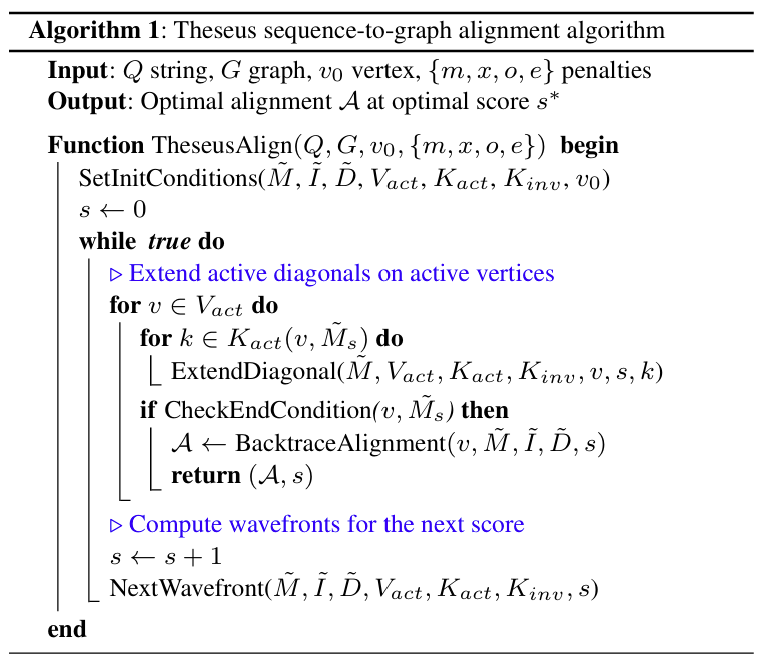
Theseus' algorithm explores the solution space in increasing order of score using Eq. 3. It starts at an initial vertex with score and continues until it reaches a path in that yields a complete alignment of . Since this is the first complete alignment of found during its score-ascending search, it is necessarily optimal and achieves the minimal alignment score . Algorithm 1 presents the overall structure of the Theseus algorithm.
At every iteration, the algorithm maintains a set of active vertices , a set of active diagonals , and a set of invalidated diagonals . We say that a vertex is active if it has at least one active diagonal, where an active diagonal is defined as a diagonal in that can be reached with score and has not yet been invalidated. Thus, the active diagonals represent the positions within active vertices where the alignment can still progress. Limiting computation to this active set allows the algorithm to focus its effort on the regions of the graph that directly influence the alignment, improving both time and memory efficiency, as can be seen in Figure 1. Each time a diagonal reaches the end of a vertex, the diagonal is added to the set of invalid diagonals in vertex . An efficient implementation of this method, accounting for the implicit invalidation of diagonals due to gap propagation, is explained in Section 3.3.
The alignment process begins by setting initial conditions. In the case of a global alignment starting at the vertex , it suffices to set (score , first wavefront). Initially, the set of active vertices is set to , the set of active diagonals is , and the set of invalid diagonals is empty. The set of active vertices and diagonals is updated in each iteration due to jumps and the opening of new diagonals resulting from insertions and deletions, respectively. Then, for each score , starting at , Theseus performs the two core operations, next and extend, until the end condition is met at score .
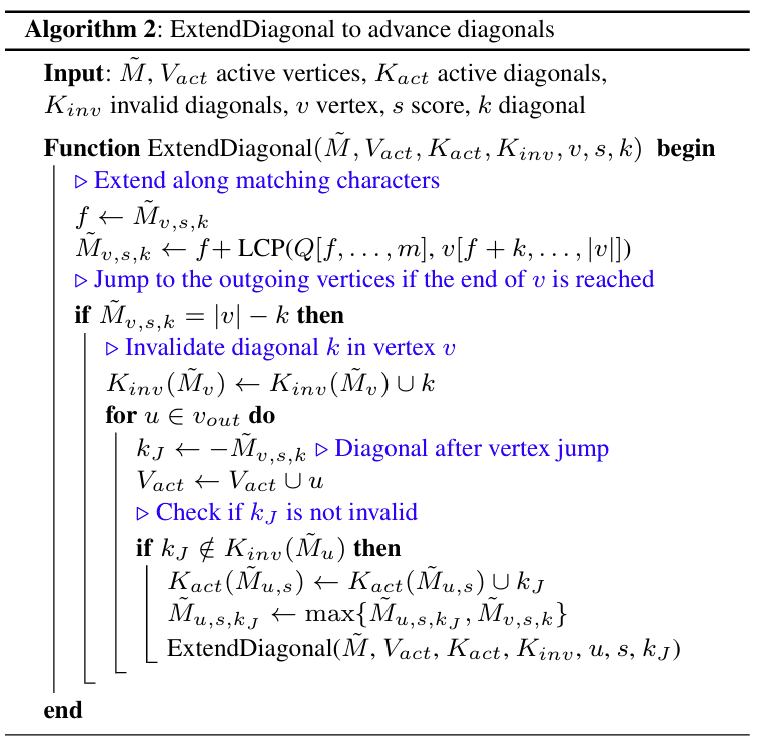
On each iteration of Algorithm 1, Theseus begins by extending each active diagonal (Algorithm 2). To that end, every active offset is greedily extended within its vertex by computing the LCP between the suffixes and . If the extension reaches the end of the vertex, that is, , the diagonal is invalidated in vertex , and the algorithm proceeds to process every outgoing vertex from . Given a vertex , we name the set of its outgoing vertices. For every , and are marked as active (if they weren't yet) and the value at diagonal is updated. If the diagonal at vertex is inactive, the extension continues within . The algorithm repeats this procedure until it finds a mismatch. Most importantly, the algorithm makes no assumptions about the graph topology and correctly handles graphs containing cycles.
After extending all active diagonals, Theseus evaluates the end condition associated with the problem at hand. In the case of global alignment with starting at vertex , for instance, the algorithm satisfies the end condition the first time the query is completely processed. When Theseus meets this condition for the first time, it traces back the path of an optimal alignment and returns it to the user, along with the optimal score .
If the end condition is not met, Theseus computes wavefronts with the next score . For each of the active vertices , the , , and wavefronts are computed based on the values at the corresponding wavefronts with a lower score, according to Eq. 3. In particular, each time that Theseus reaches the end of a vertex with an insertion, it invalidates the corresponding diagonal and continues the alignment in its outgoing vertices .
3.3 Diagonal invalidation and sparse wavefronts
According to Eq. 3, the values on any vertex may depend on wavefront values from adjacent vertices in the sequence-graph. Once a diagonal reaches the end of its associated vertex (i.e., or , for some score ) its offsets propagate to all the outgoing vertices . Thus, due to the score-ascending search of the solution space performed by Theseus, any later exploration of diagonal in vertex will be of a higher or equal score , never leading to better scoring paths. Therefore, Theseus can safely invalidate diagonal in future wavefronts at vertex , avoiding redundant work to compute suboptimal alignments.
More in detail, a diagonal can reach the end of a vertex in two distinct situations, noted as in Eq. 3. In either of these two cases, Theseus sets the corresponding diagonal as invalid, either for or . In addition, due to gap propagation on the outgoing vertices, Theseus implicitly invalidates neighboring diagonals every or scores. This is because the newly invalidated diagonals cannot produce better-scoring paths than those stemming from the associated diagonal on the outgoing vertices.
Theseus compactly represents the invalid diagonals as an ordered set of growing and non-overlapping segments of invalid diagonals. In particular, each segment consists of four values: the start and end of the range of invalid diagonals, and the remaining scores and to invalidate adjacent diagonals due to gap propagation. It is important to note that, given a vertex , the sets of invalid diagonals in , and are treated separately, as both and already incorporate the gap opening cost. Theseus initializes segments of invalid diagonals on jumps, either on or . Then, at the end of each iteration on the main loop of Alg. 1, it decreases the scores remaining to expand the segment by one as well. If a remaining value reaches zero, it is set to the default value, and the segment is expanded in the corresponding direction. Then, we sort and merge the updated set to keep it compact and non-overlapping.
This invalidation strategy is applicable to all types of directed graphs, including those with cycles. This is an important feature, as state-of-the-art diagonal invalidation strategies, such as the superbubble pruning implemented in POASTA, are limited to DAGs. Applying those strategies would hinder Theseus's ability to align sequences when cycles are present in the reference. Overall, our method is designed to operate on general directed graphs, enabling it to accurately model and process repetitive regions in the reference pangenome.
3.4 Unified Coordinate System for Efficient Sparse-Wavefront Processing
Due to the divergence of diagonals at outgoing vertices and their convergence at incoming ones, the wavefronts in Theseus are no longer inherently dense but present a sparse behavior. Consequently, we require sparse data structures to represent them, along with novel methods for efficient processing.
Theseus stores alignment information in sparse wavefronts. A sparse wavefront is a set of not necessarily ordered wavefront cells, where each of these cells stores the position of the cell in the corresponding DP matrix and additional information to perform the backtrace of the given alignment problem. However, processing sparse wavefronts introduces two challenges. First, because the cells are non-contiguous, their positions must be tracked individually. Second, the diagonals are often sparsely distributed, potentially unordered, and reused in later sparse wavefront computations, requiring a specialized strategy to process them efficiently.
First, to track sparse cells individually, Theseus proposes encoding each cell's location using its diagonal (), its offset () within that diagonal, and the vertex () where it resides.
Second, to efficiently combine sparse wavefronts across vertices and diagonals, we propose using a Unified Coordinate System (UCS). Recall , the length of the input sequence, and let be the maximum sequence length within the input sequence-graph . According to Equation 3, the range of possible diagonals that Theseus can potentially explore is . Thus, we introduce an intermediate data structure that maps sparse wavefront data into a common coordinate system of size , and then converts the result back to a sparse representation.
Figure 2 shows an example of the UCS operation. First ❶, during the Densification step, each element of the preceding sparse wavefronts is mapped to its target position in the UCS according to Equation 3, implementing the NextWavefront operation. In this process, the recurrence is applied element-wise, so that each contribution updates its target diagonal. When multiple values map to the same UCS position, we resolve the collision by taking the maximum, as defined by the recurrence 3. Second ❷, Sparsification step, once all contributions have been inserted into the UCS, we store the updated diagonals to form the resulting sparse wavefront. Third, Extension step. the ExtendDiagonal operation is executed on the resulting sparse wavefront. Finally, the UCS is prepared for a new iteration by resetting the modified diagonals to their default values. Figure 2 illustrates this 3-step process.
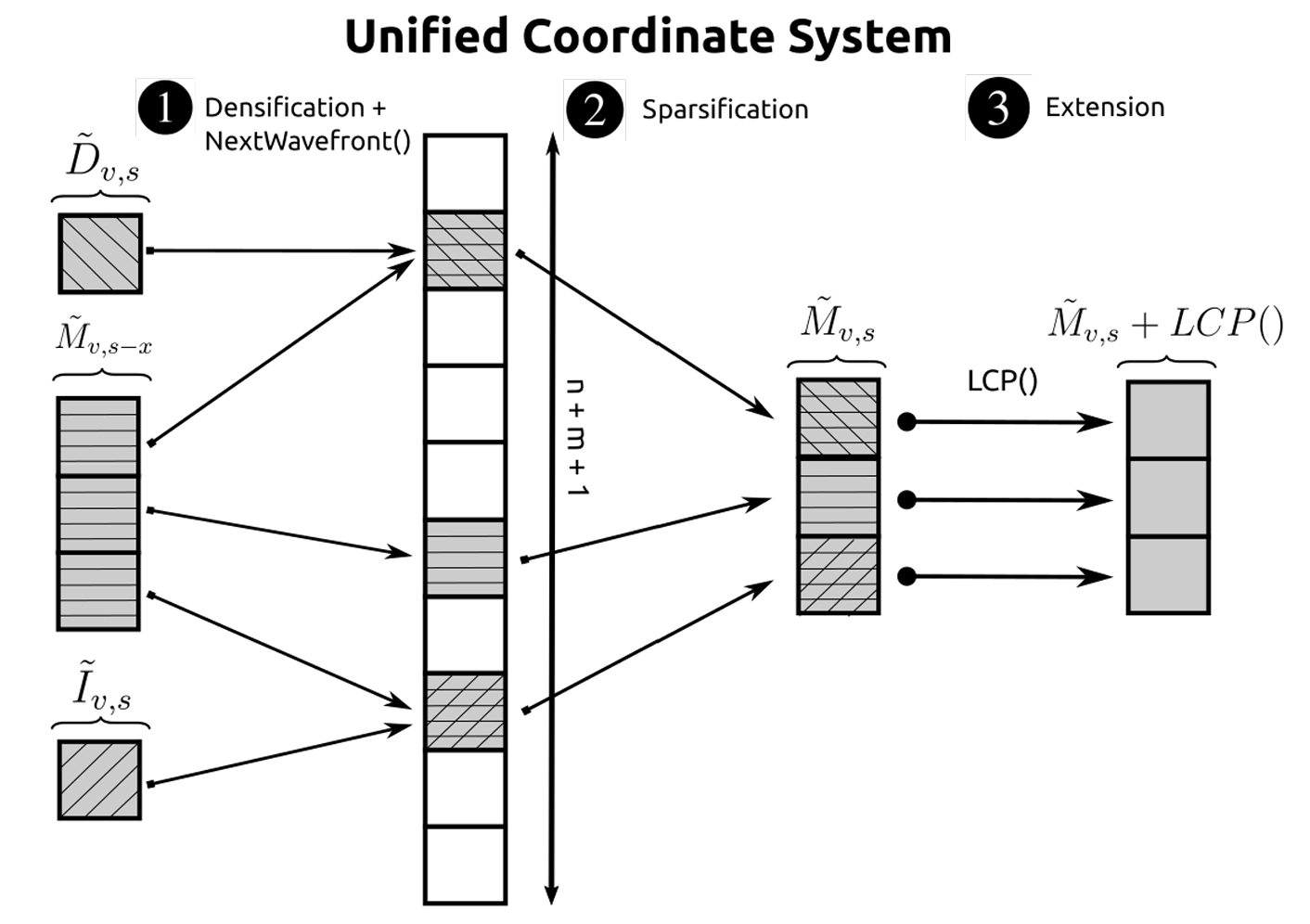
Fig.2:Example of how the Unified Coordinate System (UCS) combines previous sparse wavefronts.
3.5 Memory Efficient Sparse-Wavefront Backtrace
Usually, we are interested not only in computing the optimal alignment score but also in recovering the sequence of edit operations that transform into a sequence spelled by a path in . However, backtracking alignments in a sequence graph requires storing additional information, such as the set and order of vertices visited (i.e., a path in the reference graph).
Backtracking the optimal alignment requires storing the computed results and, once the alignment is finished, reconstructing the set of alignment operations that led to the optimal alignment score. Given its sparse nature, Theseus explicitly stores the position of the incoming cell that leads to the newly created cell. In fact, each cell not only contains its offset value, but also includes data as its vertex number and its diagonal. With all of this information and the starting position of the backtrace, Theseus is able to find the optimal alignment traceback, storing both the traversed path in the reference and the set of edit operations.
However, memory consumption is a key limiting factor for the scalability of any alignment algorithm. For this reason, Theseus takes inspiration from the Singletrack (Lopez-Villellas et al., 2025) method to reduce the memory requirements of affine-gap alignment. Singletrack reduces memory consumption by a factor of 3 by observing that the optimal alignment can be recovered from the matrix with minimal overhead during the backtrace stage. Accordingly, algorithms that implement Singletrack avoid storing the and matrices, reducing their memory footprint.
We adapt the Singletrack method to the sequence-to-graph setting in Theseus, extending its memory-efficient backtrace strategy to handle vertex transitions while maintaining optimality. As a result, we reduce memory consumption by storing only the values and the subset of jumping values. The latter are necessary because long insertions may span multiple vertices and require preserving the corresponding path information.
4 Results
We implemented Theseus as a library, publicly available at https://github.com/albertjimenezbl/theseus-lib. All datasets used for experimentation are uploaded in https://zenodo.org/records/18482097.
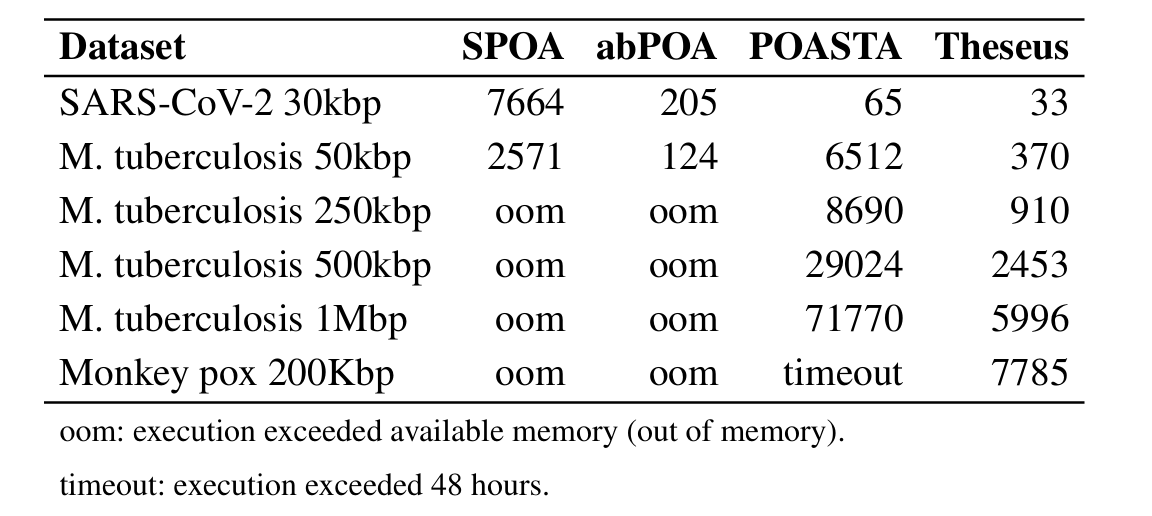
Table 1. Execution Time (in seconds) of SPOA, abPOA, POASTA, and Theseus on different datasets for the problem of MSA.
4.1 Experimental Setup
We evaluate the performance of Theseus compared to other state-of-the-art sequence-to-graph libraries and tools. First, in Section 4.2, we evaluate Theseus in the context of computing MSA, comparing it against POA-based libraries such as SPOA (Vaser et al., 2017), abPOA (Gao et al., 2021), and POASTA (van Dijk et al., 2025). Second, in Section 4.3, we evaluate Theseus for pangenome read mapping, comparing its performance against the sequence-to-graph alignment stage of vg map (Garrison et al., 2018), along with the alignment kernels of SPOA, abPOA, and POASTA. All experiments are executed single-threaded on an Intel Xeon Platinum 8480 CPU @3GHz node equipped with 256GB of DRAM.
4.2 Evaluation on Multiple Sequence Alignment (MSA)
In this section, we evaluate Theseus's sequence-to-graph alignment algorithm for computing MSA against POA-based libraries such as SPOA, abPOA, and POASTA. It is important to note that all evaluated libraries produce optimal alignments, except abPOA, which uses an adaptive banding strategy to accelerate computations, at the expense of producing suboptimal solutions. For the experiments, each aligner is provided with a set of genomic sequences that are added progressively to the POA graph until all sequences have been processed. We measure the total time and peak memory consumption spent aligning the sequences and updating the corresponding POA graph.
For the evaluation, we follow a methodology similar to that used in the POASTA work. We selected 6 datasets of varying sequence lengths (30Kbp-1Mbp): SARS-CoV-2 30Kbp, M. tuberculosis 50Kbp, M. tuberculosis 250Kbp, M. tuberculosis 500Kbp, M. tuberculosis 1Mbp and Monkey pox 200Kbp. The SARS-CoV-2 dataset contains 2732 GenBank-complete SARS-CoV-2 genome assemblies, each approximately Kbp in length. The M. tuberculosis 50Kbp, 250Kbp, 500Kbp, and 1Mbp datasets are derived from the same set of 342 RefSeq-complete whole-genome assemblies of Mycobacterium tuberculosis genomes by extracting subsequences of different lengths, all starting at the dnaG gene. Finally, the Monkey pox dataset contains 100 RefSeq-complete whole genome assemblies of Monkey pox's virus, each approximately 200 Kbp in length.
Table 1 shows the execution times of the MSA experiments. We observe that Theseus outperforms the other two optimal aligners, POASTA and SPOA, across all experiments. Specifically, Theseus is between and faster than POASTA and between and faster than SPOA. Comparing our method to the heuristic abPOA, we observe that while abPOA is faster on the M. tuberculosis 50Kbp dataset, Theseus outperforms abPOA by on the SARS-CoV-2 dataset. More importantly, Theseus is guaranteed to always produce optimal alignments, whereas abPOA trades accuracy for speed through heuristic banding and only completes two experiments, running out of memory on datasets with sequences longer than 50 Kbp. In contrast, Theseus is the only method that scales to longer sequences (i.e., 200 Kbp) while maintaining practical runtimes.
Table 2. Peak memory consumption (in GB) of SPOA, abPOA, POASTA, and Theseus on different datasets for the problem of MSA.
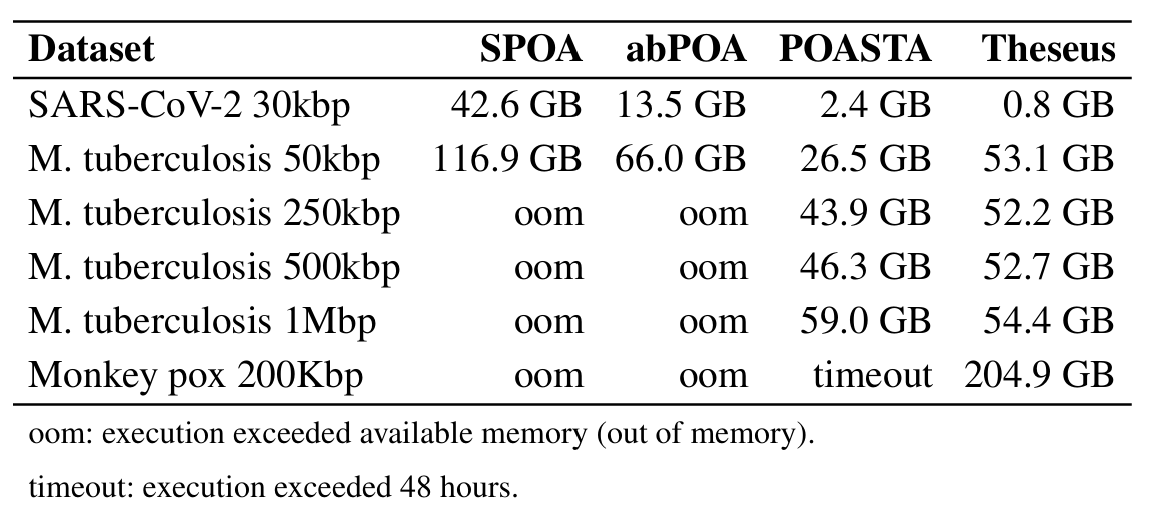
Additionally, Table 2 shows the peak memory consumption of the experiments comparing aligners. The results show that both SPOA and abPOA can only process the two smallest datasets, due to their large memory requirements, requiring 116.9GB and 66.0GB in the M. tuberculosis 50Kbp problem, respectively. In contrast, POASTA and Theseus are able to process all datasets and exhibit similar memory usage that scales with the alignment score and problem size, although POASTA exceeds the 48h runtime limit on the Monkey pox 200Kbp-long dataset.
4.3 Evaluation on Read Mapping
In this section, we evaluate Theseus' performance for pangenome read-mapping. Pangenome read-mappers, such as vg map from the vg toolkit (Garrison et al., 2018), align sequencing reads to a variation graph by combining seeding against a reference graph and sequence-to-graph alignment. The mapping process in vg map starts by finding partial exact matches between the query and the graph, in the form of Maximal Exact Matches (MEMs). Then, these seeds are clustered to identify candidate alignment regions or subgraphs. Finally, vg performs affine-gap sequence-to-graph alignment of the query against those candidate subgraphs. Our evaluation focuses on the sequence-to-graph alignment stage, isolating it from other components of the pangenome read-mapping workflow to enable a fair and informative comparison.
To perform this analysis, we use vg map to extract a collection of sequence-to-graph alignment inputs, consisting of pangenome subgraphs induced from mapping different input sequences to a human pangenome reference (built on top of the GRCh37 reference genome and containing all variation from the Phase 3 of the 1000 Genomes Project (Consortium et al., 2015) with an allele frequency ). For each input read mapped to the forward strand, we use vg map to identify clusters of Maximal Exact Matches (MEMs) and induce a candidate subgraph. As a result, we obtain a collection of sequence-to-graph alignment instances, each defined by an induced subgraph, an alignment sequence, and the starting mapping position in the graph. We modify the induced subgraph by adding an additional node pointing to the starting position to enable a fair comparison between the different methods. Then, we evaluate the performance of different aligners to compute the alignment of the input sequence to the induced subgraph.
We evaluate the alignment kernels of vg map (Garrison et al., 2018), SPOA, abPOA, POASTA, and Theseus on three short read datasets of lengths 100bp, 150bp, and 250bp. The Illumina 100bp dataset comes from individual HG00096 of the 1000 Genomes Project and the other two were extracted from the Genome in a Bottle project (Zook et al., 2016). We measure alignment throughput by each sequence-to-graph aligner across the selected datasets.
Figure 3 compares the alignment throughput of vg map, SPOA, abPOA, POASTA, and Theseus. We observe that Theseus is between and faster than the other alignment kernels. Note that the performance of Theseus is sensitive to the alignment difficulty (i.e., alignment score) of the input sequences across the different datasets and sequencing technologies. This experiment serves as a proof of concept to assess Theseus in a realistic read-mapping setting, without aiming to replace the full pangenome mapping pipeline.
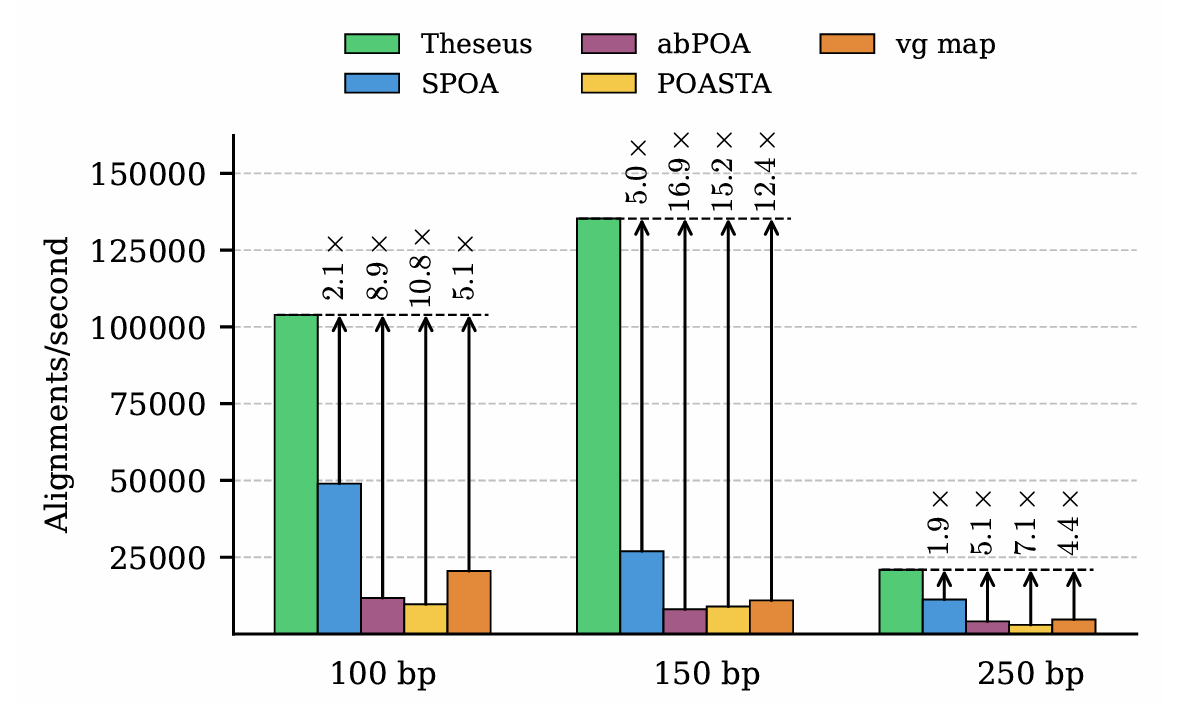
Fig.3:Alignment throughput of Theseus compared to other aligners on three datasets of 100bp,150bp, and 250bp.
5 Discussion
In this work, we present Theseus, a fast, scalable, and affine-gap sequence-to-graph aligner. Theseus exploits the expected high similarity between genomic sequences to accelerate alignment and reduce its memory footprint. Compared to other alternatives, Theseus naturally supports cycles, making it adequate to handle all sorts of directed graphs.
We introduce several algorithmic innovations to cope with the requirements of this new framework. First, we extend the affine-gap recurrence equations from the original algorithm to work with graph-like sequence references. Second, we implement a diagonal invalidation strategy that tracks previously processed and implicitly explored diagonals to avoid redundant computation. Third, we introduce the notions of sparse wavefronts and a Unified Coordinate System to handle the non-contiguous data arising from graph alignment. Finally, we introduce a memory-efficient backtrace algorithm, based on the recently published Singletrack (López-Villellas et al., 2025) approach to backtrace in pairwise alignment, tailored to the sparsity of sequence-to-graph alignment.
We evaluate Theseus on two distinct use cases, highlighting its potential as a general sequence-to-graph alignment tool. In the Multiple Sequence Alignment (MSA) problem, we observe that Theseus consistently outperforms both POASTA (van Dijk et al., 2025) and SPOA (Vaser et al., 2017) across all tested datasets, showing a to speed-up. We also compare it with abPOA, a heuristic POA aligner that accelerates computation at the expense of optimality. We demonstrate that Theseus is faster on average, while guaranteeing optimality. We also observe that Theseus is the only tool that scales to larger problems while maintaining manageable runtimes. In the Read Mapping use case, intended as a proof of concept of Theseus's capabilities, we compare Theseus with the alignment kernels of vg map, SPOA, POASTA, and abPOA on short reads. We observe that Theseus is between and faster than the other aligners.
Overall, Theseus bridges the gap between optimality and scalability in sequence-to-graph alignment. By combining output-sensitive exploration with sparse wavefront processing, it enables affine-gap alignment on large and cyclic graphs at a practical cost. As a result, we expect Theseus to provide a suitable building block for next-generation MSA pipelines and scalable pangenome analysis as reference graphs and datasets continue to grow in the future to come.
Funding
This work was supported by the Spanish Ministry, Ministerio para la Transformación Digital y de la Función Pública, and the European Union - NextGenerationEU through the Catedra Chip UPC project (grant number TSI-069100-2023-0015), the Spanish Ministry of Science and Innovation MCIN/AEI/10.13039/501100011033 (contracts PID2022-136454NB-C22, PID2023-146193OB-I00, and PID2023-146511NB-I00), by the Gobierno de Aragón (E45_20R T58_23R research groups), the Arm-BSC Center of Excellence, the European Union's Horizon Europe Programme under the STRATUM Project (grant agreement no. 101137416), and by the Barcelona Zettascale Laboratory, backed by the Ministry for Digital Transformation and of Public Services, within the framework of the Recovery, Transformation, and Resilience Plan - funded by the European Union - NextGenerationEU. The funders had no role in the study design, data collection and analysis, the decision to publish, or the preparation of the manuscript.
References
(2018). Computational pan-genomics: status, promises and challenges. Briefings in bioinformatics, 19(1), 118-135.
Aguado-Puig, Q., Doblas, M., Matzoros, C., Espinosa, A., Moure, J. C., Marco-Sola, S., and Moreto, M. (2023). Wfa-gpu: Gap-affine pairwise read-alignment using gpus. Bioinformatics, 39(12), btd701.
Alonso-Marin, A., Fernandez, I., Aguado-Puig, Q., Gomez-Luna, J., Marco-Sola, S., Mutlu, O., and Moreto, M. (2024). Bimsa: accelerating long sequence alignment using processing-in-memory. Bioinformatics, 40(11), btae631.
Chin, C.-S., Wagner, J., Zeng, Q., Garrison, E., Garg, S., Fungtammasan, A., Rautiainen, M., Aganezov, S., Kirsche, M., Zarate, S., et al. (2020). A diploid assembly-based benchmark for variants in the major histocompatibility complex. Nature communications, 11(1), 4794.
Compeau, P. E., Pevzner, P. A., and Tesler, G. (2011). How to apply de bruijn graphs to genome assembly. Nature biotechnology, 29(11), 987-991.
Consortium, G. P. et al. (2015). A global reference for human genetic variation. Nature, 526(7571), 68.
Darby, C. A., Gaddipati, R., Schatz, M. C., and Langmead, B. (2020). Vargas: heuristic-free alignment for assessing linear and graph read aligners. Bioinformatics, 36(12), 3712-3718.
Doblas, M., Lostes-Cazorla, O., Aguado-Puig, Q., Cebry, N., Fontova-Muste, P., Batten, C. F., Marco-Sola, S., and Moreto, M. (2023). Gmx: Instruction set extensions for fast, scalable, and efficient genome sequence alignment. In Proceedings of the 56th Annual IEEE/ACM International Symposium on Microarchitecture, pages 1466-1480.
Doblas, M., Lostes-Cazorla, O., Aguado-Puig, Q., Iñiguez, C., Moreto, M., and Marco-Sola, S. (2025a). Quicked: high-performance exact sequence alignment based on bound-and-align. Bioinformatics, 41(3), btd112.
Doblas, M., Shih, P. J., Lostes-Cazorla, O., Moreto, M., Batten, C., and Marco-Sola, S. (2025b). Smx: Heterogeneous architecture for universal sequence alignment acceleration. In Proceedings of the 58th IEEE/ACM International Symposium on Microarchitecture, pages 1656-1671.
Eizenga, J. M., Novak, A. M., Sibbesen, J. A., Heumos, S., Ghaffari, A., Hickey, G., Chang, X., Seaman, J. D., Rounthewaite, R., Ebler, J., et al. (2020). Pangenome graphs. Annual review of genomics and human genetics, 21(1), 139-162.
Gao, Y., Liu, Y., Ma, Y., Liu, B., Wang, Y., and Xing, Y. (2021). abpoa: an sim-based c library for fast partial order alignment using adaptive band. Bioinformatics, 37(15), 2209-2211.
Garrison, E., Sitter, J., Novak, A. M., Hickey, G., Eizenga, J. M., Dawson, E. I., Jones, W., Garg, S., Markello, C., Lin, M. F., et al. (2018). Variation graph toolkit improves read mapping by representing genetic variation in the reference. Nature biotechnology, 36(9), 875-879.
Goodwin, S., McPherson, J. D., and McCombie, W. R. (2016). Coming of age: ten years of next-generation sequencing technologies. Nature reviews genetics, 17(6), 333-351.
Gotoh, O. (1982). An improved algorithm for matching biological sequences. Journal of molecular biology, 162(3), 705-708.
Gotoh, O. (1999). Multiple sequence alignment: algorithms and applications. Advances in biophysics, 36, 159-206.
Haghi, A., Marco-Sola, S., Alvarez, L., Diamantopoulos, D., Hagleitner, C., and Moreto, M. (2023). Wfa-fgpa: An efficient accelerator of the wavefront algorithm for short and long read genomics alignment. Future Generation Computer Systems, 149, 39-58.
Hart, P. E., Nilsson, N. J., and Raphael, B. (1968). A formal basis for the heuristic determination of minimum cost paths. IEEE transactions on Systems Science and Cybernetics, 4(2), 100-107.
Ivanov, P., Bichsel, B., Mustafa, H., Kahles, A., Ratsch, G., and Vechev, M. (2020). Astarix: Fast and optimal sequence-to-graph alignment. In International Conference on Research in Computational Molecular Biology, pages 104-119. Springer.
Jain, C., Zhang, H., Gao, Y., and Aluru, S. (2020). On the complexity of sequence-to-graph alignment. Journal of Computational Biology, 27(4), 640-654.
Kavya, V. N. S., Tayal, K., Srinivasan, R., and Sivadasan, N. (2019). Sequence alignment on directed graphs. Journal of Computational Biology, 26(1), 53-67.
Lee, C., Grasso, C., and Sharlow, M. F. (2002). Multiple sequence alignment using partial order graphs. Bioinformatics, 18(3), 452-464.
Li, H., Feng, X., and Chu, C. (2020). The design and construction of reference pangenome graphs with minigraph. Genome biology, 21, 1-19.
Liao, W.-W., Asri, M., Ebler, J., Doerr, D., Hauckness, M., Hickey, G., Lu, S., Lucas, J. K., Monlong, J., Abel, H. J., et al. (2023). A draft human pangenome reference. Nature, 617(7960), 312-324.
López-Villellas, L., Pineda-Sánchez, E., Badouh, A., Marco-Sola, S., Ibáñez, P., Alastruey-Benedé, J., and Moreto, M. (2023). Risc-v for genome data analysis: opportunities and challenges. In 2023 38th Conference on Design of Circuits and Integrated Systems (DCIS), pages 1-6. IEEE.
López-Villellas, L., Langarita-Benítez, R., Badouh, A., Soria-Pardos, V., Aguado-Puig, Q., López-Paradís, G., Doblas, M., Setoain, J., Kim, C., Ono, M., et al. (2024). Genarchbench: A genomics benchmark suite for arm hpc processors. Future Generation Computer Systems, 157, 313-329.
López-Villellas, L., Iñiguez, C., Jiménez-Blanco, A., Aguado-Puig, Q., Moreto, M., Alastruey-Benedé, J., Ibáñez, P., and Marco-Sola, S. (2025). Singletrack: An algorithm for improving memory consumption and performance of gap-affine sequence alignment. bioRxiv, pages 2025-10.
Marco-Sola, S. and Ribeca, P. (2015). Efficient alignment of illumina-like high-throughput sequencing reads with the genomic multi-tool (gem) mapper. Current Protocols in Bioinformatics, 50(1), 11-13.
Marco-Sola, S., Sammeth, M., Guigó, R., and Ribeca, P. (2012). The gem mapper: fast, accurate and versatile alignment by filtration. Nature methods, 9(12), 1185-1188.
Marco-Sola, S., Moure, J. C., Moreto, M., and Espinosa, A. (2021). Fast gap-affine pairwise alignment using the wavefront algorithm. Bioinformatics, 37(4), 456-463.
Marco-Sola, S., Eizenga, J. M., Guarracino, A., Paten, B., Garrison, E., and Moreto, M. (2023). Optimal gap-affine alignment in o(s) space. Bioinformatics, 39(2), btd074.
Miga, K. H. and Wang, T. (2021). The need for a human pangenome reference sequence. Annual Review of Genomics and Human Genetics, 22, 81-102.
Miller, J. R., Koren, S., and Sutton, G. (2010). Assembly algorithms for next-generation sequencing data. Genomics, 95(6), 315-327.
Myers, G. (1999). A fast bit-vector algorithm for approximate string matching based on dynamic programming. Journal of the ACM (JACM), 46(3), 395-415.
Navarro, G. (2000). Improved approximate pattern matching on hypertext. Theoretical Computer Science, 237(1-2), 455-463.
Needleman, S. B. and Wunsch, C. D. (1970). A general method applicable to the search for similarities in the amino acid sequence of two proteins. Journal of molecular biology, 48(3), 443-453.
Rautiainen, M. and Marschall, T. (2020). Graphaligner: rapid and versatile sequence-to-graph alignment. Genome biology, 21(1), 253.
Rautiainen, M., Makinen, V., and Marschall, T. (2019). Bit-parallel sequence-to-graph alignment. Bioinformatics, 35(19), 3599-3607.
Tettelin, H., Riley, D., Cattuto, C., and Medini, D. (2008). Comparative genomics: the bacterial pan-genome. Current opinion in microbiology, 11(5), 472-477.
van Dijk, L. R., Manson, A. L., Earl, A. M., Garimella, K. V., and Abeel, T. (2025). Fast and exact gap-affine partial order alignment with poasta. Bioinformatics, 41(1), btae757.
Vaser, R., Sović, I., Nagarajan, N., and Šikić, M. (2017). Fast and accurate de novo genome assembly from long uncorrected reads. Genome research, 27(5), 737-746.
Zhang, B., Zhu, W., Diao, S., Wu, X., Lu, J., Ding, C., and Su, X. (2019). The popular pangenome provides insights into the evolutionary history of the genus. Communications biology, 2(1), 215.
Zook, J. M., Cateo, D., McDaniel, J., Yang, L., Spies, N., Sidow, A., Weng, Z., Liu, Y., Mason, C. E., Alexander, N., et al. (2016). Extensive sequencing of seven human genomes to characterize benchmark reference materials. Scientific data, 3(1), 1-26.