6.2 User data format for an independent lane
1 General
This subclause specifies the mapping of samples from one or more converters in the same device to octets for transmission over a single lane. This specification is backward-compatible with JESD204A and JESD204B. However, the position of tail bits may differ from JESD204 version April 2006.
2 User data mapping without oversampling
One device contains (M) converters, each producing (N) data bits per sample. The numbering scheme for all items in the below figures will start from 0. Within a sample, the leftmost bit is the most significant bit (MSB) and the rightmost bit is the least significant bit (LSB). The process of mapping the samples to octets is described in the following steps:
-
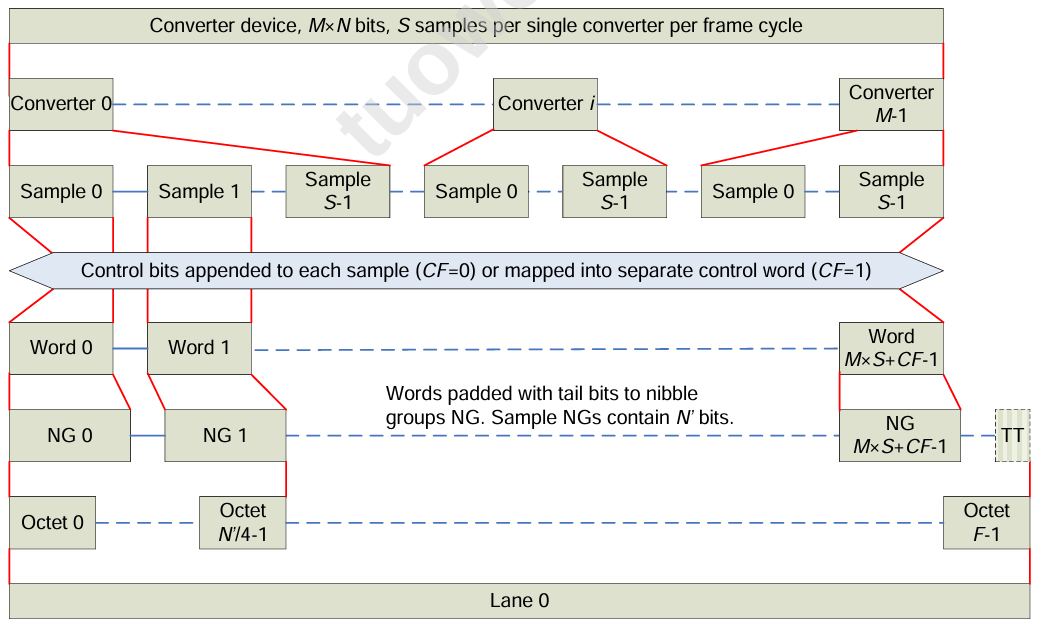
The samples are mapped to a linear axis, starting with converter 0, followed by converter 1, etc. until all samples have been mapped.
-
The samples are mapped to words. When the samples contain no control bits (e.g., overrange indication), the words are identical to the samples. When sample-specific control bits are available, there are two options:
- a. A conversion word is formed by appending the relevant control bits after the LSB of each conversion sample. The number of control bits per sample is indicated by parameter CS.
- b. A conversion word is identical to the corresponding sample. The control bits are grouped into a separate control word, which is appended after the words containing the samples. The first bit(s) of the control word correspond(s) to the control bit(s) of converter 0, the next bit(s) in the control word correspond(s) to the control bits of converter 1, etc.
If (CF ) is the number of control words in the frame, with (CF = 0) or (CF = 1) for an independent lane, the total number of words transmitted per frame cycle is thus (M + CF).
-
It is recommended, for words not containing a whole multiple of 4 bits, to extend each word to the smallest possible nibble group (group of half octets) using tail bits. The extended words are indicated by "NG" in Figure 53. This step is optional and may be disregarded in cases where highest line efficiency is prioritized against easier reconfigurability in mapping. A conversion word may thus be extended by control and/or tail bits to a length of (N' >= N) bits, where (N' ) is recommended to be a whole multiple of 4. Note that for (CF = 0), control bits are considered part of the data word and there will be no tail bits between data and control bits, but one or more tail bits could be necessary after the control bit(s). For (CF = 1), data and control bits are in different words and one or more tail bits could be necessary after the data bits of each sample.
-
If necessary, tail bits are appended to make the total number of bits after the last step a whole multiple of 8.
-
The sequence obtained in the previous step is regrouped into (F) octets.
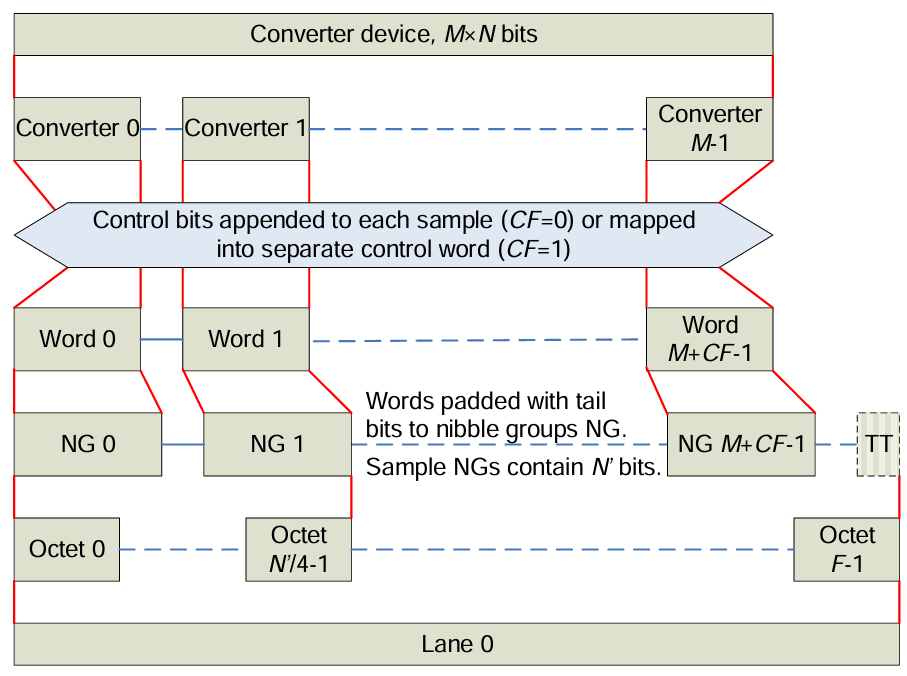
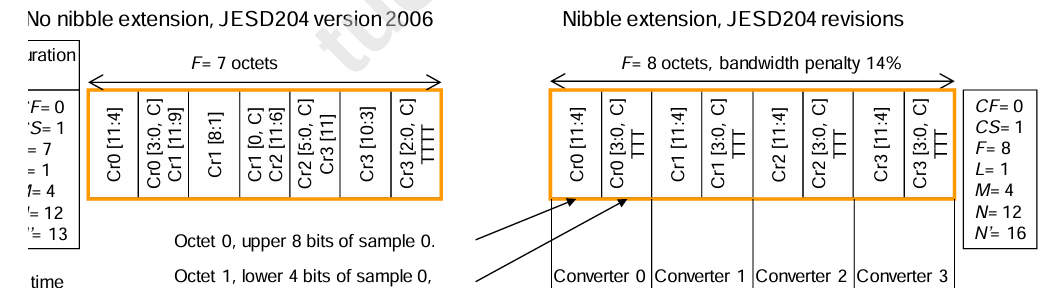
Figure 54 illustrates the difference in the recommended location of tail bits in version 2006 of JESD204 and later versions. In version 2006, tail bits were only inserted at the end of a frame. The newer versions recommend that tail bits be inserted at the end of each sample, if needed to fill a nibble group. In this example the new mapping method needs one extra octet per frame.
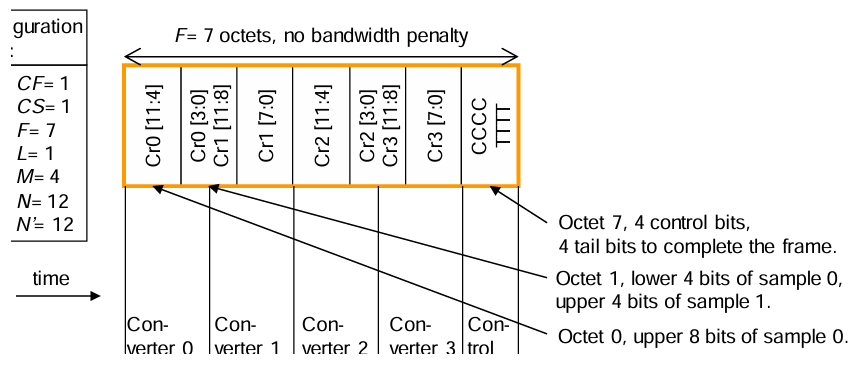
EXAMPLE: Compacting the frame structure by using a control word.
Figure 55 illustrates how grouping the control bits into a control word can reduce the amount of tail bits and enable a shorter frame.
3 User data mapping with oversampling
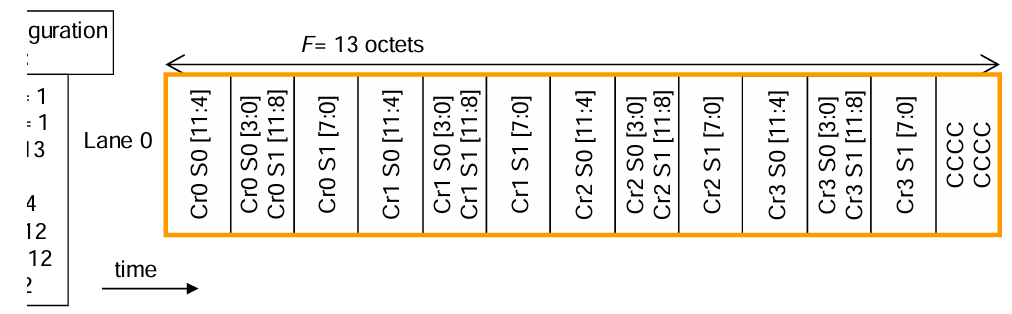
The mapping used with oversampling is similar to the mapping without oversampling. The general principle is illustrated in the below figure. Instead of one sample per converter, (S) samples are cascaded before mapping the data of the next converter.
EXAMPLE: Mapping for a (4 \times 12)-bit converter with two times oversampling and control word.